Guillermo Kuitca Vaga Idea de una Pasión
Sotheby’s May, 2001. Guillermo Kuitca (b. 1961) Vaga Idea de una Pasión Catalogue Essay by Julia P. Herzberg.
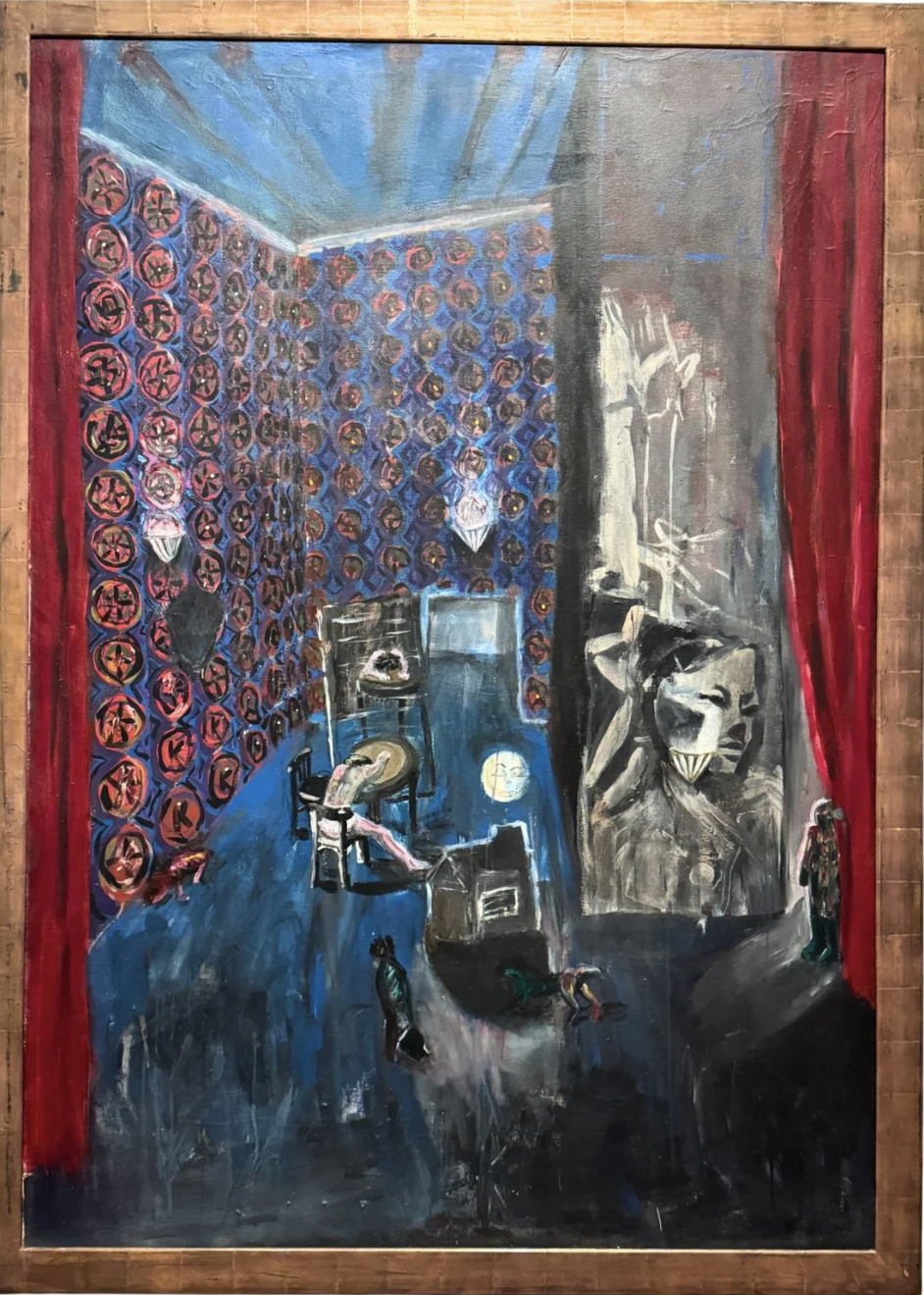
Guillermo Kuitca Vaga idea de una pasión, 1985
Vaga Idea de una Pasión, painted in the mid-eighties, is a pivotal work. It looks back on some significant steps that shaped the artist’s development and also foreshadows his later explorations. This painting is designed as a theatrical set viewed through the proscenium. Each of the three characters is located in a specific position downstage, center stage, and stage left. The scene is presented as if the director was blocking out the scene and, in a given moment, told the cast to stop and hold their places. Kuitca had internalized what it meant to paint as if he were directing a play.
Guillermo Kuitca’s interest in the theater goes back many years, beginning with a course in the history of cinema and stage direction while he was still in high school. In 1980 the artist joined Pina Bausch’s Tanztheater in Wuppertal, Germany, where for a time he worked as a stagehand and jack-of-all trades. Kuitca’s experience with Tanztheater affected his work throughout the 1980s. The artist, for example, directed two plays between 1982 and 1984, Nadie olvida nada (Nothing Is Ever Forgotten) and El Mar dulce (The Sweetwater Sea), both of which spurned a series of paintings with the same titles. Those as well as subsequent ones were composed as a stage set: time, space, and narration were suspended. Kuitca drew the viewer into his imaginary space with a long shot, rendering the view from above or below. The narrative was ambiguous, the action suspended, the drama intense.
Vaga Idea de una Pasión fits this paradigm. In subsequent works, the actors would slowly disappear from the script, replaced by the presence of absence. Here in this painting the relationship among the woman, the child, and the man is withheld. It seems from the expressionistic body language of the male actor that we the viewer have come upon a scene bursting with angst. Perhaps we need to write the untold script.
Julia P. Herzberg, Ph.D.©
Art historian and curator