Liliana Porter, Untitled, 1980
by Julia P. Herzberg
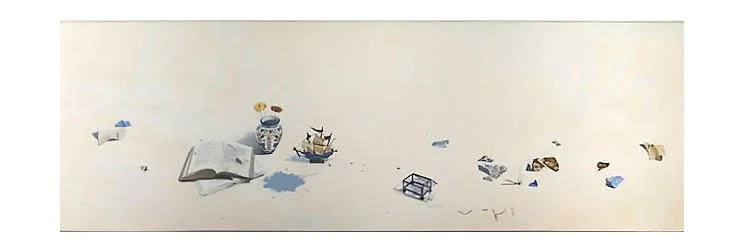
Untitled, 1980 was in the Herzberg collection since 1982. Photo credit the artist.
Liliana Porter began her artistic practice as a printmaker and then expanded the limits of traditional printmaking during and after her years as one of three founding members of the New York Graphic Workshop (1964-1970). [1] Her conceptual and material innovations that included the act of wrinkling, the use of shadows, and drawings with lines changed her practice by challenging the veracity of representation. [2] The following works present some of the exploratory results that found fertile ground in her ongoing practice, including in the language of the painting Untitled of 1980.
In 1967 Porter became fascinated with the idea of wrinkling paper in printmaking. She explored the aesthetics of wrinkling in a number of works that year and in the following two years. Two installations, Development of a Wrinkle Installation I & II, were exhibited respectively in 1969 in the Fine Arts Museums in Caracas and Santiago. [3] If you fast forward to 1980, you find twelve wrinkled papers in Untitled.
Among Porter’s radical explorations in printmaking Shadows /Sombras of 1969, at the Instituto Torcuato Di Tella in Buenos Aires, is a site-specific installation of the shadows of people painted on a wall with acrylic. [4] The artist’s objectives were to challenge the viewer’s perception of reality. In conversation with Porter, she remarked that her hand-painted shadows around all the images in Untitled were intended to impart a reference to natural light when in actuality none existed. [5]
Untitled and The Line, of 1973, are now iconic works. Untitled was an installation of silkscreen on a wall with string and nails shown in the Project Series at the Museum of Modern Art in New York. The nails were images printed directly on the wall with silkscreen to look like real nails; real string was inserted through small holes around the silkscreened nails on the wall to extend to the real nails that had been installed on the floor. The objective was to create a discontinuity between reality and illusion, a trope that curses throughout her work.
The Line uses photoetching and pencil lines to reveal an interesting process that begins with a photograph of the artist’s hand. When the print was developed, Porter drew a line on her forefinger and then reprinted the entire image. When the photoetching was finished, the artist drew a real line connected to the original line she had drawn. Her conceptual strategy and technical expertise enabled her to question the layers of representation that tricked the eye.
In 1980, the year Liliana Porter painted and silkscreened Untitled, the artist was awarded the Guggenheim Fellowship to continue developing an innovative body of work that began in the mid-to late 1960s. From that time, Porter’s graphic work had expanded the limits of traditional printmaking through a range of conceptual strategies and conceits that had come to mark her work as exceptionally experimental. During the artist’s ‘Guggenheim’ year she continued to develop a visually engaging and deftly humorous body of work of which Untitled is a loadstar.
As in much of the artist’s work, the subjects in Untitled address time, place, literature, art history, popular culture, image making, and the nature of representation.[6] In considering these subjects—‘time’ may be alternately defined as non-specific, anytime, or simultaneous times; ‘place’ is not rendered as a traditional representational scene, although the images are of objects in her studio; ‘subject matter’ draws on her interests in literature, art history, travel, and popular culture; ‘image-making’ demonstrates her technical, material, and conceptual approaches to painting and silk-screening; and the ‘nature of representation’ questions the fluidity of reality and its illusion.
In unpacking the imagery impeccably composed across the canvas, we are intrigued by the artist’s repertoire of common, everyday objects that arguably emanate a magical presence. In the lower left, there are two barely visible dots of blue paint that draw our eye into the composition. Above those dots we note two small pieces of hand-torn folded papers –a white one with a sketchy drawing of the top of a sail boat and a plain blue one. As our eye moves toward the right, simultaneously following many small splatters of blue paint, we glimpse another tiny fragment of printed paper folded in the middle and collaged on the white painterly canvas. These images, including bits of paint and the collaged piece of paper, guide us to the silkscreened and painted images of two open books, one printed over the other with two additional fragments of paper on one of the pages; [7] a vase with two flowers, a sail boat, and a relatively large splash of blue paint with splattering across the two books and much of the white canvas. This intriguing group of objects features two pages from Lewis Caroll’s Alice’s Adventures in Wonderland and two pages from Irás y no volverás, a book of poems by José Emilio Pacheco. [8] Following the individual splashes of painted blue dots across the composition, we discover an image of a glass and bronze box with a tiny wad of colored thread that winds out over the side of the box onto the canvas, where the assemblage of real string weaves in and out of the lower right area of the painting reinforcing the horizontality of the composition. Above the glass and bronze box, Porter placed a small blue bird leading the eye to three small pieces of torn, printed paper next to two matches and another piece of tiny blue creased paper. Above that creased paper, Porter overlaid two fragments of partial faces of three women sourced from two postcards: one fragment from Botticelli’s The Madonna of the Magnificat, and the other two from Raphael’s The Marriage of the Virgin. [9]
Porter had radically cropped their faces, challenging us to identity them from an infinite number of artistic representations in circulation. To the upper right of the Botticelli and Raphael images, we detect another tiny white folded paper, making a total of five wrinkled fragments in this particular mise-en-scene. The three final images on the right, in perfect spatial relationship to each other, include a yet smaller hand-torn fragment of the same Botticelli motif from a postcard of The Madonna of the Magnificat. The scene ends as poetically and quietly as it began—with two folded pieces of paper—one blue and one white—similar in form, reversed in order.
Untitled of 1980, composed as a nontraditional narrative, is a portrait of the artist’s studio. It looks back on strategies and conceits of her early work and anticipates the “situations” in her later work—photography, installations, and videos. Conceptually, the painting continues to advance the ways in which wrinkles, shadows, and lines question the readings of the picture.
We are introduced to Alice, who held a fascination for the artist, perhaps due to the nature of wonderment—an important element in Porter’s work. The sail boat, another motif from the artist’s early work emblematizes a journey—whether geographical, cultural, or existential or a beginning or an end.
The repetition of twelve pieces of hand-torn papers tells us something about the aesthetics of a wrinkle and its significance in printmaking. Whether wrinkled, folded, or duplicated, paper is a fundamental material and also a motif in Porter’s language and practice. Untitled challenges us to rethink our concepts regarding representation. Are the hand-painted shadows around each image real because they were actually painted to look real? Are the holy women on the postcards just simulacra, thereby undermining the notion of originality? Is the pooling of thick blue paint real because Porter painted it? Do the tiny splashes guiding us across the composition actually spatter as they appear to? And finally is the collaged piece of tiny printed paper and the real thread in the canvas more real than their virtual others?©
1 The New York Graphic Workshop was founded by Luis Camnitzer, Liliana Porter, and José Guillermo Castillo in New York. From 1964 to 1970 the artists aimed at “. . . stretching the formal limits of printmaking by considering the conceptual connections of the media to a broad range of objects produced in serialized ways or as multiples, such as posters, Coca-Cola bottles, or even sliced cold cuts. In other words, as artists, they investigated ways to print on any surface as long as the image on that surface can be reproduced.” Their multiple objectives included printing other people’s work commercially; working as master printers; organizing cultural activities; and doing their own work. See “Manifesto of The New York Graphic Workshop,” in The New York Graphic Workshop 1964-1970, pp. 93, 94.
2 For further reading on the subjects, sources, and meanings in Porter’s work, see the extensive bibliography on http:www.lilianaportercom. I have recently reviewed: Moro, Humberto. Liliana Porter: Other Situations. Savannah, GA: SCAD (Savannah College of Art and Design), 2021; Katzenstein, Inés. Liliana Porter In Conversation with / En Conversación con Inés Katzenstein. Introductory essay by Gregory Volk. New York: Fundacíon Cisneros, 2013; The New York Graphic Workshop 1964-1970. Editors Gabriel Pérez-Barreiro, Ursula Davila-Villa, Gina McDaniel. Austin, Tex.: Blanton Museum of Art, The University of Texas at Austin, 2009. Bazzano Nelson, Florencia. Liliana Porter and the Art of Simulation. Burlington, VT: Ashgate Publishing Company, 2008; Liliana Porter: Fotografía y Ficción. Buenos Aires: Centro Cultural Recoleta, 2004.
3 See Bazzano-Nelson for further discussion of the wrinkled murals and their relationship to disposable art, p. 27. For a reproduction and discussion, see Katzenstein, Liliana Porter in Conversation, p. 34.
4 See a reproduction in Katzenstein, Liliana Porter in Conversation, p. 34.
5 Telephone conversation with the artist on May 12, 2023.
6 Porter explained the following basic steps: She photographs each object and then traces the outline of the objects on the canvas that she has painted and prepared. She then silkscreens them on the canvas and hand-paints each image including the dots and splashes of blue paint, and the shadows around the images.
7 In 1980 Porter also became interested in printing additional pieces of paper over the surfaces of prints, in part to draw attention to the underlying image and to reinforce the visual materiality of an image. Two of several examples include End of the Journey and Reconstruction III, both of 1980. The first work is illustrated in Bazzano-Nelson, p. 76; the second is located in the artist’s archival records.
8 In a conversation with Liliana Porter on May 5, 2023, she spoke about Pacheco, who was a young writer friend of hers when she lived in Mexico from 1958 to 1961. The subject of Alice in Wonderland began in 1980 and continued through the mid-1980s. Two examples of several prints and paintings from 1980 featuring images of the written pages of a book, together with illustrations of Alice, the sail boat, and pieces of paper include: The Book of Alice (or: The Pool of Tears), etching, Chine Collé and collage; The Unending Story, acrylic, silkscreen, drawing, painting, and collage on canvas. These works are illustrated in Bazzano-Nelson, pp. 77, 78.
9 In a phone conversation with the artist on May 5, 2023, Porter identified Botticelli’s painting in the Uffizi and Raphael’s at the Brera in Milan. She also identified Porter’s archives hold an impressive record of postcards and other paraphernalia that have often served as models for her imagery.